
Dedicated Vs Staff Augmentation: Ownership, Overhead, and Commitment Compared

Dedicated vs staff augmentation comes down to three things. Dedicated teams give the provider delivery ownership and remove most hiring overhead, in exchange for longer commitment. Staff augmentation keeps ownership in-house and stays flexible, but your managers absorb the work.
Most companies do not choose an engagement model. They inherit one, usually because a vendor pitched it during a hiring crunch and it stuck.
That decision quietly sets who runs standups, who owns the roadmap, who replaces a developer who quits, and who answers for a slipped release.
Getting it wrong rarely shows up as a line item. It shows up as your VP of Engineering spending Fridays on vendor coordination instead of architecture.
The market keeps moving in both directions at once. In a Deloitte survey of more than 500 business and technology executives, 70% reported bringing previously outsourced work back in-house over the past five years.
In the same survey, 67% had adopted outcome based outsourcing models, up from 45% two years earlier. Companies are not settling on one answer. They are getting more deliberate about which work sits where.
This guide compares dedicated vs staff augmentation on three criteria that actually change the outcome: ownership, overhead, and commitment.
Ownership decides who controls the work. Overhead decides how much management load your organisation absorbs. Commitment decides how long the arrangement has to hold to pay off.
You will get a direct comparison, a look at where the real costs sit, four situations with a recommendation for each, and questions to work through with your leadership team.
No claim that one model wins. They solve different problems, and the expensive mistake is using one to solve the other’s problem.
Dedicated Teams Vs Staff Augmentation at a Glance
Staff augmentation adds individual engineers to a team you already manage. A dedicated development team is a managed unit that the provider runs on your behalf, working only on your product.
| Factor | Dedicated Team | Staff Augmentation |
|---|---|---|
| Ownership | Shared. You own product direction, the provider owns delivery | You own everything, including day to day management |
| Management | Provider supplies a lead or delivery manager | Your managers, same as internal staff |
| Team structure | Cross functional unit assembled by the provider | Individual specialists slotted into your structure |
| Commitment | Usually six months and up | Weeks to months, often renewable |
| Flexibility | Composition changes through the provider | You add or release individuals directly |
| Overhead | Lower for you, priced into the rate | Higher for you, absorbed by your managers |
| Recruitment responsibility | Provider | Provider sources, you interview and decide |
| Scaling | Adds capability, slower to change shape | Fast for headcount, limited for whole functions |
| Product knowledge | Accumulates and stays with the team | Leaves when the contract ends |
| Best suited for | Ongoing product development, no internal team | Skill gaps, capacity spikes, defined workstreams |
| Delivery model | Outcome and scope based | Time and materials |
| Long term suitability | Strong | Workable, but knowledge retention becomes a risk |
Read the table by column, not by row. Dedicated teams trade flexibility for stability and take management work off your plate. Staff augmentation trades stability for control and gives that work back to you.
Neither is universally cheaper. They move cost between your operating budget and your management bandwidth.
What Is A Dedicated Development Team?
A dedicated development team is a group of engineers employed by a provider, assigned exclusively to one client, and managed as a unit rather than as individuals.
The provider assembles the team, employs everyone, and usually appoints a technical lead or delivery manager who runs the day to day. That team works on your product only. It does not rotate onto other accounts between sprints.
A typical unit has backend and frontend engineers, a QA specialist, a tech lead, and a shared or part time DevOps and design resource. Composition follows the roadmap rather than a fixed template.
You keep product ownership. You set priorities, approve scope, sign off releases, and decide what gets built. That part does not move.
The provider takes on hiring, contracts, payroll, HR, equipment, and replacement. If someone resigns, sourcing a substitute is their problem, not a req you have to open.
Communication runs through the team as a whole. You attend sprint reviews, talk to the lead about scope and blockers, and speak with engineers directly.
What changes is that you are not the escalation point for individual performance.
Most engagements run six months to several years. Shorter than that and the ramp cost swallows the benefit.
The model suits companies with a continuous roadmap and no internal engineering function to extend. Product companies, funded startups, and enterprises spinning up a new business line all fit.
How a Dedicated Development Team Works in Practice
A logistics company decides to rebuild its customer portal and keep developing it for at least two years. It has three internal engineers, all committed to the legacy ERP.
Instead of hiring six people, it engages a dedicated team of eight. The provider’s tech lead runs delivery. The company’s product manager owns the backlog.
Eighteen months later that team knows the carrier integrations better than anyone internal, and turnover has been handled without a single internal req.
What Is Staff Augmentation?
Staff augmentation is a resourcing model where external engineers join your existing team and work under your management, on your processes, for an agreed period.
The provider sources and employs the engineer. You interview, you decide, and from day one that person sits inside your team structure. They join your standups, use your tooling, follow your definition of done, and take work from your backlog.
You manage them. Your engineering manager assigns tasks, reviews performance, handles blockers, and decides what they work on this week. There is no external delivery lead.
The provider handles employment mechanics: contracts, payroll, statutory compliance, benefits, and replacement if the engagement breaks down. Their commercial relationship with you is a rate and a notice period.
Engagements commonly run three to twelve months. Extensions are routine when the fit is good. Ending one is usually a matter of weeks of notice rather than a contract renegotiation.
The flexibility is real. You can add a Kubernetes specialist for a migration, then release them when it lands, without carrying a permanent salary.
The catch is that everything the augmented engineer learns about your systems walks out with them. That is fine for a bounded piece of work and costly for core product development.
How Staff Augmentation Works in Practice
A fintech company with fourteen internal engineers commits to a PCI compliance deadline in five months. Nobody on the team has done it before.
They bring in two augmented engineers with payments security experience, plus a senior React developer to cover feature work that would otherwise stall. All three report to the existing engineering manager.
When the audit passes, two roll off. The React developer is extended for another quarter.
Ownership: Who Controls The Work in Each Model
Dedicated teams split ownership: you own the product, the provider owns delivery. Staff augmentation gives you all of it, which is either the main advantage or the main cost depending on your management capacity.
Team Management
With staff augmentation, your managers manage. One to ones, performance conversations, task assignment, and capacity planning all sit with your engineering leadership. An augmented engineer is functionally a member of your team who happens to be paid by someone else.
With a dedicated team, the provider’s lead handles that layer. You engage with the team through its lead and through ceremonies, not through individual supervision.
If your engineering managers are already at capacity, adding five augmented engineers does not add five engineers of output. It adds five people to manage on top of a full load.
Project and Product Ownership
Product ownership stays with you in both models. Nobody hands the roadmap to a vendor.
The difference is who translates that roadmap into execution. Under augmentation, your team does it. Under a dedicated team, the provider’s lead does it and reports back against what you agreed.
Technical Decision Making
Architecture usually stays in-house under augmentation. Augmented engineers work within decisions your team has already made and rarely have standing to overturn them.
A dedicated team is more often given authority to make architectural calls, particularly on greenfield work. That helps when you have no internal architect, and it needs governance when you do.
Agree upfront which decisions require your sign off. Framework selection, data model changes, and anything touching security usually should.
Resource Management
Under augmentation you decide who joins, who stays, and who goes, individual by individual. That control is direct and immediate.
Under a dedicated team, composition changes are a conversation with the provider. Slower, but the provider carries the risk of finding the replacement and covering the gap.
Delivery Accountability
This is where the models genuinely diverge. Under staff augmentation, a missed deadline is your problem. The provider supplied competent people. What happened after that is on your management.
Under a dedicated team with an outcome based agreement, the provider carries some delivery accountability. Get this written down. Vague accountability in a contract is worth nothing when a milestone slips.
Overhead: What Each Model Costs You to Run
Dedicated teams move most operational overhead to the provider and price it into the rate. Staff augmentation leaves recruitment mechanics with the provider but keeps management overhead with you.
Recruitment sits with the provider under both models, though the shape differs. Augmentation providers send candidates and you run interviews. That still costs your senior engineers hours per hire.
Onboarding is yours either way. Nobody is productive on day one on a codebase they have never seen, and ramp is measured in weeks.
With a dedicated team you pay that once for the unit. With augmentation you pay it per person, every time.
Payroll, HR, benefits, and compliance sit with the provider in both models. That is the clearest saving, particularly when engineers work from another country.
Replacement is where the models separate. Under augmentation, losing a specialist mid engagement means a gap, a new search, and a fresh ramp. Under a dedicated team, the provider covers it and the surrounding team preserves context.
Management overhead is the line most comparisons skip. Five augmented engineers consume real hours from your engineering managers every week. That time has a cost, and it comes out of the same people you need for architecture and technical strategy.
Vendor coordination cuts the other way. Dedicated teams need governance: steering calls, milestone reviews, escalation paths. Lighter than daily management, but not free.
Total Cost of Ownership: Looking Past The Hourly Rate
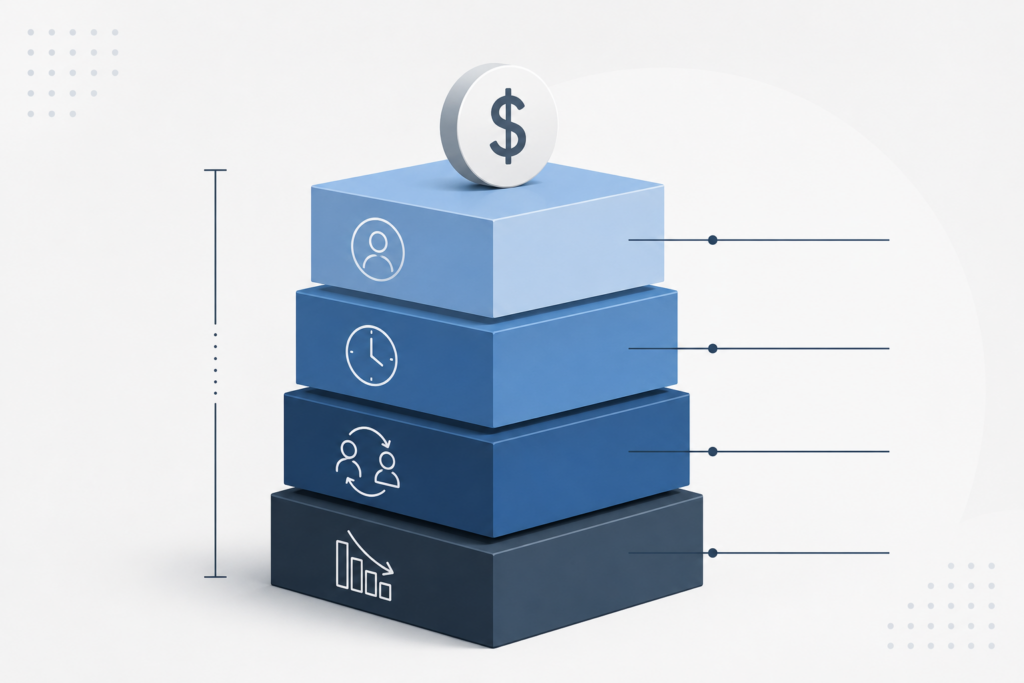
The lowest hourly rate frequently produces the highest total cost. Total cost of ownership counts everything the model consumes, not just the invoice.
For an honest comparison, count direct resource cost, internal management hours at loaded cost, and recruitment and interview time.
Then add onboarding for each person, the gap when someone leaves, rework caused by lost context, and the cost of scaling as needs change.
Augmentation looks cheaper per hour and per month, and that holds while engagements stay short and bounded.
Over several years, repeated ramp cycles erode the advantage. Each departure resets part of the accumulated understanding, and the replacement bills full rate while learning what the last person already knew.
Dedicated teams front load cost instead. The rate carries the provider’s management layer, and efficiency improves as the team compounds product knowledge.
Where the two cross over depends on how much context your codebase demands. A documented service with clean boundaries ramps quickly. A twelve year old monolith does not.
Commitment: Engagement Length and Team Continuity
Dedicated teams require longer commitment and repay it with continuity. Staff augmentation asks for less and gives you less durable knowledge in return.
Dedicated engagements usually start at six months, often with annual renewal. Ending one takes notice and a transition plan.
That constraint has a purpose. Continuity is what lets an engineer say “we tried that in March and here is why it failed.” Documentation does not replicate it.
Augmentation lets you change course quickly. If a project is cancelled, you unwind commitments in weeks, and for companies with uncertain funding that optionality is worth paying for.
The trade is institutional knowledge. Every rollover restarts part of the learning curve, and the parts nobody documented get rediscovered the hard way.
One caveat worth stating plainly. Continuity is relative, not absolute. US Bureau of Labor Statistics data put median employee tenure at 3.9 years in January 2024, down from 4.1 years in 2022 and the lowest since 2002.
Internal hires are not permanent either. So the honest comparison is not stability against churn. It is who carries the cost of churn when it happens, and how much context survives it.
Commitment becomes an advantage when your roadmap extends beyond a year and the work is genuinely continuous. It becomes a liability when the work is finite and you would be paying for capacity you no longer need.
Where Each Model Goes Wrong
Both models fail in predictable ways. The failures are worth knowing before you sign, because most of them are preventable with three or four contract clauses.
Dedicated Teams That Stop Being Teams
The most common failure is the team becoming a black box. You get sprint reports and burndown charts, quality drifts, and nobody notices until a release goes badly.
The fix is access rather than reporting. Ask for repository access, review commit history and pull request discussion occasionally, and put a quarterly technical review by someone outside the team into the agreement.
The second failure is quiet rotation. The contract says dedicated, and eight months in two engineers are splitting time with another account. Name individuals in the agreement and require notice before anyone moves.
The third is stagnation. Two years in, nobody proposes changing anything because the client never asked them to think that way. Build architectural review into the cadence rather than waiting for someone to raise a hand.
Augmentation That Quietly Becomes Permanent
The classic failure is drift. A three month engineer is still there three years later and is now the only person who understands the billing service.
Set a review date at the start of every augmented engagement and actually hold it. If the answer is that the work is now continuous, that is a signal to change model rather than extend again.
Deloitte’s 2026 analysis describes exactly this transition, citing a financial services organisation moving from staff augmentation to results driven delivery models.
The second failure is management dilution. Your engineering manager goes from six reports to twelve, one to ones stop happening, and output per person drops across the whole team, not just the new arrivals.
Cap span of control before you add people. If adding four augmented engineers means someone needs a team lead underneath them, budget for that too.
The third is knowledge walking out at notice period speed. Make documentation a contractual deliverable, and pair every augmented specialist with an internal engineer who stays.
Key Differences That Actually Change The Decision
Strip away the feature comparison and four things decide it.
- Who absorbs management load. Augmentation puts it on your managers. Dedicated teams put it on the provider and charge for it.
- Who carries delivery risk. Augmentation leaves it with you. Dedicated teams can share it, if the agreement says so explicitly.
- Where knowledge lives. Augmented engineers take context with them. Dedicated teams accumulate it and keep it in one place.
- How fast you can change direction. Augmentation unwinds in weeks. Dedicated teams need a transition.
Everything else follows from those four.
When to Choose A Dedicated Development Team
Choose a dedicated team when your roadmap runs beyond a year and you need capacity that improves rather than resets.
It fits when you have no internal team to extend and building one would take nine months you do not have.
It fits when the work needs several complementary skills at once, because assembling a unit beats running five separate searches.
It fits when internal management capacity is thin, because a provider supplied lead absorbs coordination that would otherwise land on your CTO.
And it fits when institutional knowledge is a competitive asset. Domain heavy products, regulated systems, and messy integrations all reward a team that has been there two years.
Explore Dedicated Development Team Services to see how these teams are structured and governed.
When to Choose Staff Augmentation
Choose staff augmentation when you have a functioning engineering team and a specific gap to close.
It fits when the gap is a skill, not a headcount. Bringing in someone who has run a Kafka migration before is faster than teaching your team to run their first one.
It fits when the constraint is temporary. A launch quarter, a compliance deadline, a migration window. Permanent hiring for temporary load creates a problem six months later.
It also fits when requirements are still moving and you need to adjust capacity without renegotiating a contract, or when you simply will not delegate task assignment. That preference is legitimate.
Four Situations and What Usually Works
These four are composites built from common patterns, not accounts of specific DSGGTech clients. The details are generalised on purpose.

1. A Startup Building A New SaaS Product
Post seed, a technical founder, no engineering team, eighteen months of roadmap.
A dedicated team usually wins. The founder cannot manage five individual contractors and sell at the same time. Continuity matters because the product will change shape repeatedly.
The counterargument: if the product direction is still genuinely unsettled, a small augmented group for three months of prototyping is the cheaper way to find out what to build.
2. An Enterprise with An Existing Engineering Team
Forty engineers, mature processes, a modernisation programme adding load.
Augmentation usually fits better. Management structure exists, standards are set, and adding engineers into that structure is straightforward.
The exception: a distinct new product with its own roadmap can justify a separate dedicated team rather than stretching the existing one.
3. A Temporary Skills Gap
A payments integration nobody internal has done, with a hard deadline.
Augmentation, clearly. You need specific expertise for a defined period. A dedicated team would be overbuilt for a three month problem, and the commitment would outlast the need.
Pair the augmented specialist with an internal engineer so knowledge stays after they leave.
4. Building Long Term Product Engineering Capability
An established company standing up a software product as a new revenue line, with a three year plan.
A dedicated team is the stronger fit, and the reasoning is compounding knowledge rather than cost. Consider a hybrid if internal hiring runs in parallel, so the external team can taper as internal capacity grows.
Can You Combine Dedicated Teams and Staff Augmentation?
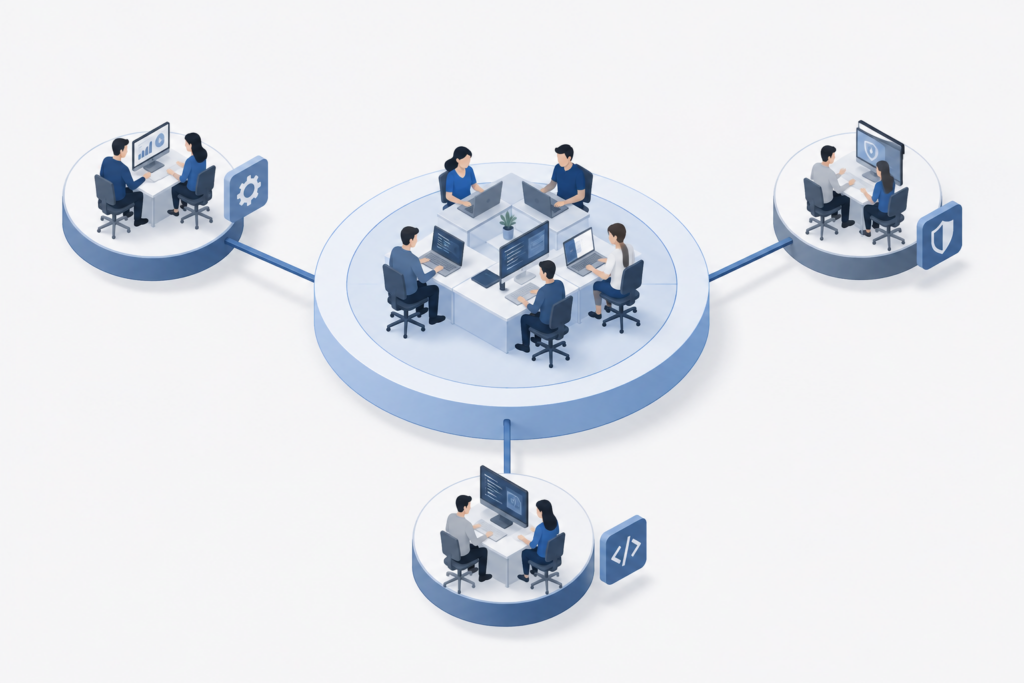
Yes, and mature engineering organisations often do.
A common pattern is a dedicated team holding the core product with augmented specialists brought in for bounded work: a security audit, a performance sprint, a cloud migration.
Another is an internal team owning architecture and the customer facing product while a dedicated external team owns a separate service or platform component with clear boundaries.
Hybrids work when responsibilities are drawn cleanly. They fail when three groups share a backlog and nobody owns delivery.
Set one delivery owner, define which team owns which components, and agree a single escalation path. Without that, hybrid becomes a coordination tax.
If you are weighing a hybrid, our IT Consulting Services team can map responsibilities before you commit.
How to Choose The Right Engagement Model
Work through these with your engineering and product leadership. The answers usually converge quickly.
- Do we have an internal engineering team capable of absorbing new people, or are we starting from nothing?
- Is this need bounded by a date, or continuous?
- Do we need one or two specific skills, or an entire delivery capability?
- Who will actually manage these engineers day to day, and do they have the capacity?
- How many management hours per week can we spare before something else suffers?
- How much does our system depend on undocumented context?
- How likely is it that our requirements change substantially in the next six months?
- If a milestone slips, who should be accountable?
- Are we building a product that keeps evolving, or completing a defined project?
- Do we want a supplier or a technology partner with a view on our architecture?
Choose a dedicated team if the work is continuous, you lack internal management capacity, and knowledge retention matters.
Choose staff augmentation if you have a functioning team, the gap is specific, the timeline is bounded, and you want direct control.
Consider a hybrid if you need stable core capacity plus periodic specialist input, and you can define clear ownership boundaries.
Dedicated vs Staff Augmentation: Which Is Better?
Neither. The question is which one matches your situation, and the honest answer usually depends on two variables: how long the work lasts and how much management capacity you have.
Dedicated teams are generally better for long term product development, stable capacity, and situations where you need delivery managed for you.
Staff augmentation is generally better for targeted skill gaps, temporary capacity, and organisations that want to keep full control of day to day execution.
Hybrid models work when you need both continuity and flexibility, provided ownership boundaries are explicit.
If you find yourself arguing that one model is better in the abstract, you are probably answering the wrong question.
FAQs about Dedicated Teams and Staff Augmentation
What is the difference between dedicated teams and staff augmentation?
A dedicated development team is a managed unit the provider runs on your behalf, working only on your product. Staff augmentation adds individual engineers to your existing team under your management. The difference is who manages delivery: the provider in one case, you in the other.
Is staff augmentation cheaper than a dedicated development team?
Usually per hour, but not always in total. Augmentation adds management load to your internal team and resets knowledge each time someone rolls off. Over engagements running longer than a year, repeated onboarding and lost context often close the gap. Compare total cost of ownership, not rates.
Which model gives more control?
Staff augmentation gives more control over individuals, since augmented engineers work under your managers and take direction from your backlog. Dedicated teams give more control over outcomes, since the provider is accountable for delivery. Which matters more depends on whether your constraint is management capacity or execution detail.
Who manages a dedicated development team?
The provider does, usually through a technical lead or delivery manager who handles task assignment, performance, and day to day coordination. You keep product ownership: priorities, scope, and release decisions. The provider also handles employment, replacement, and HR administration for the team.
When should I use staff augmentation?
When you have a functioning engineering team and a specific gap. Common triggers are a missing skill such as a cloud migration or compliance expertise, a temporary capacity spike before a launch, or a defined workstream with a clear end date. It suits situations where the need is bounded.
When should I choose a dedicated development team?
When your roadmap extends beyond a year, you lack an internal team to extend, or your engineering managers cannot absorb more direct reports. Dedicated teams also suit domain heavy products where accumulated knowledge is a competitive asset and turnover would be expensive.
Can staff augmentation work for long term projects?
It can, but knowledge retention becomes the risk. Each rollover takes undocumented context with it. If you use augmentation long term, invest in documentation, pair augmented engineers with internal staff, and expect to pay ramp cost more than once. Many companies switch to a dedicated team once the work becomes continuous.
Can a company combine dedicated teams and staff augmentation?
Yes. A common pattern is a dedicated team owning the core product with augmented specialists added for bounded work such as a security audit or migration. Hybrids need one delivery owner, clear component boundaries, and a single escalation path, otherwise coordination overhead cancels the benefit.
Final Takeaway
Three things decide it. Ownership tells you who runs the work. Overhead tells you how much of that load your organisation carries. Commitment tells you how long the arrangement has to hold to be worth it.
Answer those against your roadmap length, your team structure, the expertise you actually need, and your management capacity. The model tends to pick itself.
The costly mistake is not choosing the wrong model. It is choosing one for a short term reason and living with it for three years.
DSGGTech builds both dedicated development teams and augmented engineering capacity across software development, cloud, and data engineering. If you are weighing the two, talk to our technology specialists about your roadmap, your current team, and how much management load you can realistically absorb. We will tell you which model fits, including when the answer is neither.