

What Enterprise AI Actually Costs: Pilot, Production and the Gap Between

A cost-planning guide for technology leaders budgeting enterprise AI. Sets three indicative cost bands from POC through production, breaks total spend into five components (data, model, infrastructure, integration, security), explains why the pilot-to-production jump is the expensive one, lists the recurring costs that fall outside build budgets, and gives a simple ROI method. Roughly 2,100 words, 2,500 after the recommended additions.
Enterprise AI implementation is evolving into a strategic investment for businesses aiming to enhance operational efficiency, automate routine activities and aid data-driven decisions. However, the cost of introducing artificial intelligence often extends beyond software licenses and model development.
An AI proof of concept (POC) might need a fairly small investment, but the same solution in an organization is accompanied by extra technical and operational costs to implement. System integration, compliance and ongoing maintenance, data preparation, and security can all add greatly to the overall budget.
This difference between pilot and production costs is important when planning enterprise AI projects. Companies need to consider not only upfront costs associated with the development but also the costs of operating reliable AI systems. Knowledge of these cost elements may enable organizations to have realistic budgets, focus on appropriate use cases and avoid unforeseen expenses incurred in implementation.
McKinsey’s State of AI survey, published in November 2025, found that 88% of organizations now use AI in at least one business function, while only about one-third have begun scaling AI across the enterprise. The distance between those two figures is what this article is about.
What Does Enterprise AI Implementation Actually Include?
Enterprise AI implementation deals with a number of activities that are interrelated to introduce artificial intelligence in business operations. It starts with the definition of appropriate use cases and how the proposed solution can be supported with the technology infrastructure that is already in place.
This task typically involves the evaluation of data, the choice of a model, the development of the AI, the integration and the deployment of the system. Businesses can utilize ready-made models or refine existing models or create their own machine learning solutions depending on the needs of the project.
Another crucial element is infrastructure planning. Storage, compute, API access and security controls all have to be provisioned before AI workloads can run. Due to this fact, enterprise AI implementation should be considered as an ongoing technology investment rather than a one-time software development expense.
Enterprise AI Implementation Cost: Pilot vs Production
Enterprise AI costs differ significantly based on scope of the project, complexity of the model, data readiness and deployment requirements. An existing LLM API chatbot will not cost the same as a custom predictive analytics platform. The following figures provide indicative planning ranges in USD. They are illustrative project-budget estimates, not fixed industry prices or vendor quotations.
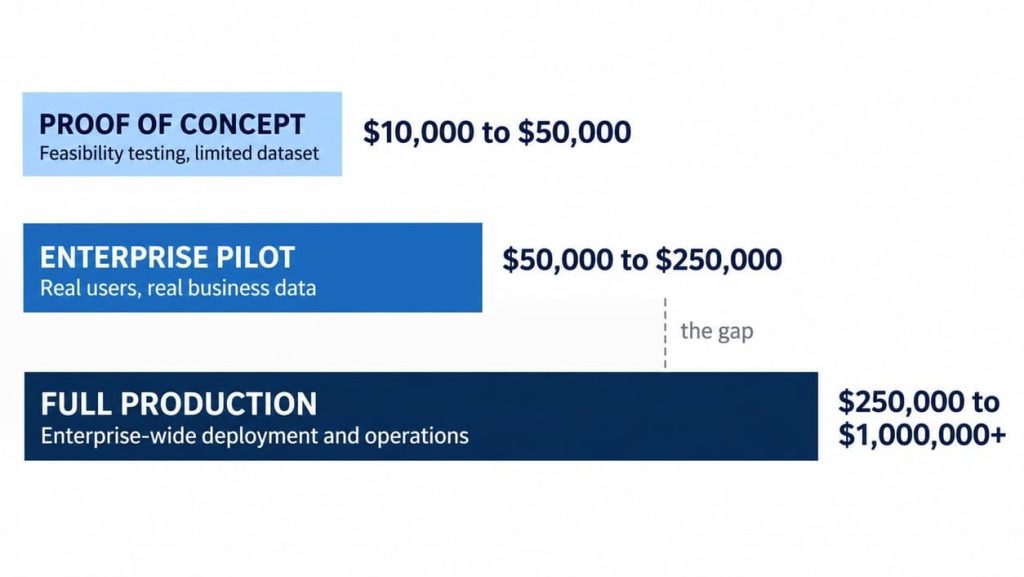
| Implementation Stage | Estimated Cost | Typical Scope |
| Proof of Concept (POC) | 50,000 | Feasibility testing on a limited dataset |
| Enterprise AI Pilot | 250,000 | Testing with real users and real business data |
| Full-scale Production | $250,000 – $1,000,000+ | Enterprise-wide deployment and ongoing operations |
How Much Does an AI Proof of Concept (POC) Cost?
An AI proof of concept typically costs between $10,000 and $50,000. It is created to determine whether a certain business issue can be tackled using an AI solution. At this stage, development is usually restricted to a small dataset, limited functionality and a controlled testing environment.
As an illustration, a business can create a simple AI chatbot to find out whether it can access pertinent information in internal documents. The aim is to establish feasibility, define technical constraints and comprehend business worth before making a bigger investment.
What Is the Cost of an Enterprise AI Pilot?
An enterprise AI pilot typically costs between $50,000 and $250,000. Unlike a POC, a pilot is tested using more realistic business conditions and a wider group of users.
Data preparation, model customization, API integration, cloud resources, testing as well as security reviews are all possible expenses. As an example, a financial services company can roll out a document processing solution that utilizes AI in a single department and then expand it to various business operations.
How Much Does Full-Scale Enterprise AI Production Cost?
Full-scale enterprise AI implementation can require $250,000 to more than $1 million, depending on deployment complexity. There is the need to have enhanced infrastructure in the production environments, enterprise-grade integrations, access controls, monitoring systems as well as disaster recovery arrangements.
An example of this is the implementation of an AI assistant to serve several departments which might need to be connected to CRM, ERP, HR and document management systems. Additional investment might be necessary in model optimization, governance, staff training and technical maintenance.
Breaking Down the Major Costs of Enterprise AI Implementation
Knowing individual cost components can assist businesses to understand which areas they are investing in implementation budgets. Although project costs differ, five areas make up a large share of enterprise AI investment.
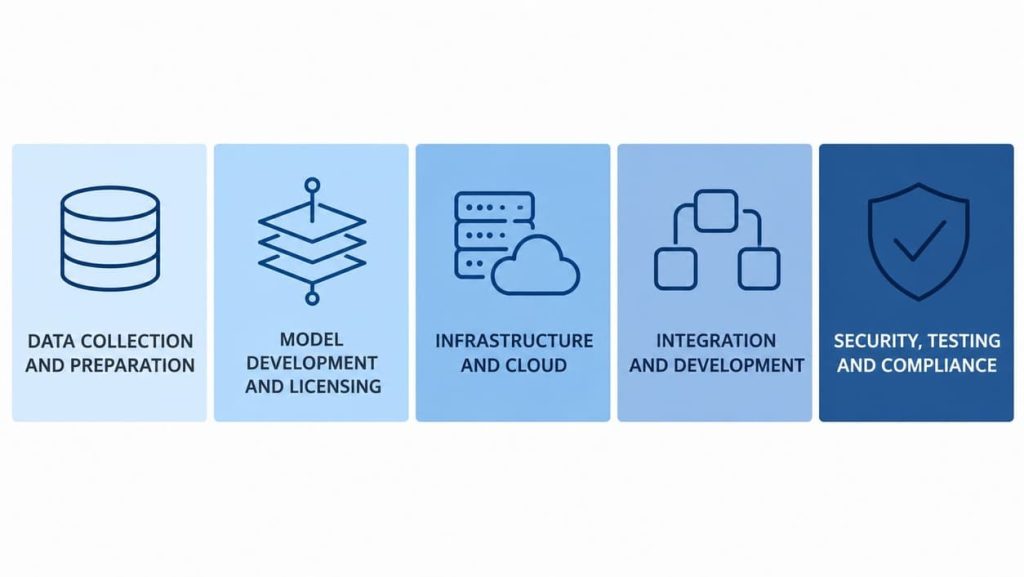
1. Data Collection and Preparation Costs
AI systems require accurate, pertinent and well-organized data. The process of gathering information that businesses require, filtering out similar records, correcting inconsistencies and structuring datasets might be necessary before they can start the process of model development.
Switching costs could be higher since information may be stored in legacy databases, spreadsheets, and disconnected applications. Additional resources may be needed in data labelling, annotation, and pipeline development.
2. AI Model Development and Licensing Costs
The costs associated with models will relate to the decision of businesses to adopt pre-trained models, customized solutions or custom-built machine learning systems.
APIs can be used to run existing AI models, decreasing the development needs. Nonetheless, API subscriptions, token consumption, fine-tuning, and licensing charges have to be taken into consideration. The custom model development is often associated with extra cost in engineering know-how, training data, experimentation and testing.
3. Infrastructure and Cloud Computing Costs
AI workloads need computing resources for training models, inference, storage and application hosting. Companies that implement large language models could require a connection to GPUs, premium servers and dedicated cloud providers.
Stanford HAI‘s 2025 AI Index measured the cost of querying a model at roughly GPT-3.5’s level on the MMLU benchmark: $20 per million tokens in November 2022, down to $0.07 by October 2024, a reduction of more than 280 times. Read that figure carefully. It tracks the falling price of a fixed capability, not the trajectory of your bill. Most enterprises find total inference spend rises anyway, because usage grows faster than unit prices fall.
4. AI Integration and Software Development Costs
AI applications rarely operate independently within enterprise environments. They have a tendency to share information with an existing CRM, ERP, HR and other business applications. The developers might have to create APIs, set up data connectors, alter the existing software and create authentication systems.
5. Security, Testing and Compliance Costs
Enterprise AI systems should be tested in terms of accuracy, reliability, data privacy and security weaknesses. Costs can cover penetration testing, managing access, encryption, compliance analyses and model testing.
Why Does Moving from AI Pilot to Production Cost More?
A successful AI pilot demonstrates technical feasibility, but production deployment introduces operational requirements that are often absent during initial experimentation. The importance of these additional investments is reflected in McKinsey’s 2025 research, which found that only about one-third of surveyed organizations had started scaling their AI programs across the enterprise. The incremental investment is usually in the form of preparing enterprise data, connecting existing applications that are available and creating controls that facilitate reliable usage.
-
Data Quality and Enterprise Readiness
Pilot projects may utilize small datasets which have already been cleaned and organized. Production systems must process larger volumes of information from multiple sources. To have consistent outputs, data standardization, access permissions, validation and pipeline maintenance are necessary.
-
Integration with Existing Business Workflows
A pilot can operate as a standalone application. Production AI needs to be integrated with the current business processes and software. This involves further development, API setup, authentication and workflow adjustments. The ability of the compatibility with legacy applications may further add to the costs of implementation.
-
Scalability, Reliability and Performance
The applications used in production should be able to handle more than one user, simultaneous requests and varying workloads. Disaster recovery systems, performance monitoring, load balancing, and redundancy may be required by businesses.
-
Governance, Security and Human Oversight
The production AI must have well-defined access controls, audit trails, output validation and escalation processes. Human review can also be a requirement when it comes to sensitive decisions in the form of financial transactions, customer information or regulated business processes.
Factors That Influence Enterprise AI Implementation Cost
A number of business and technical factors determine the ultimate implementation budget.
- Complexity of the business use case: A retrieval chatbot built on an existing model API sits at the low end. Custom predictive analytics, autonomous agents and decision-support systems sit at the high end, because each requires its own training data, evaluation and oversight.
- Data availability and quality: Incomplete, fragmented or unstructured datasets are costlier to prepare and process.
- AI model and technology stack: Fine-tuning and premium APIs may make the model and technology stack more expensive to develop and operate.
- Number of integrations: Multiple enterprise applications can be integrated with more development and testing needs.
- Deployment environment: Clouds have varying infrastructure and maintenance needs, as well as on-premises and hybrid environments.
- Security and regulatory requirements: There are also strict privacy, audit and compliance costs.
- Development approach: Internal teams, external implementation partners and hybrid delivery models have different cost structures.
- Project timeline and team size: Compressed delivery timelines and larger engineering teams both raise cost, usually more than clients expect.
Hidden Costs Businesses Often Overlook
Initial development budgets rarely represent the complete cost of enterprise AI ownership. Several recurring expenses may emerge after deployment.
- Employee training and AI adoption: Employees need guidance on using AI applications, validating outputs and incorporating new tools into existing workflows.
- Continuous model monitoring: Models require regular performance checks to identify inaccurate outputs, latency issues and unexpected behavior.
- Model updates and retraining: Changing business requirements and evolving datasets may require model adjustments or retraining.
- Cloud usage fluctuations: Increasing users, API requests and inference workloads can raise monthly infrastructure expenses.
- Third–party subscriptions: Vector databases, monitoring platforms, security tools and external APIs may involve recurring charges.
- Technical support and maintenance: Dedicated engineering resources may be required for troubleshooting, optimization and application updates.
How to Calculate the ROI of Enterprise AI Implementation
Enterprise AI investment should be evaluated against measurable business outcomes rather than technical performance alone.
Step 1 – Identify Measurable Business Outcomes
Businesses should establish baseline metrics before implementation. These may include employee hours saved, processing costs, customer response times, error rates and revenue improvements.
For example, an AI-powered document processing system may reduce the time employees spend reviewing invoices and extracting information.
Step 2 – Use a Simple AI ROI Formula
Use this formula to estimate the financial return:
ROI (%) = ((Annual Financial Benefit – Total Investment) / Total Investment) x 100
For example, if an AI implementation generates $150,000 in annual financial benefits against a total investment of $100,000, the calculated ROI is 50%.
Development, infrastructure, maintenance and employee training costs are supposed to be included by businesses in calculations of total investment.
How to Control Enterprise AI Implementation Costs
The phased approach can be used to handle enterprise AI budgets in a more efficient way.
- Start with a clearly defined business problem.
- Use cases whose benefits can be measured (financial or operational) should come first.
- Reuse existing infrastructure wherever practical.
- Choose models based on performance requirements and budget.
- Introduce phased deployment instead of implementing everything simultaneously.
- Measure infrastructure usage, performance and operating costs continuously.
Choosing the Right Enterprise AI Implementation Partner
An implementation partner with experience must know AI architecture, integrations to the enterprise, cloud infrastructure, and security needs. When making a selection, consider past deployments, technical capabilities, transparency of the project and post-launch care.
Frequently Asked Questions
- How much does enterprise AI implementation cost?
A proof of concept typically runs $10,000 to $50,000, a pilot $50,000 to $250,000, and full production $250,000 to more than $1 million.
- Why is production AI more expensive than a pilot?
The production needs scalability, enterprise integration, security measures, monitoring and continuous maintenance.
- How long does enterprise AI implementation take?
A basic POC takes 4 to 8 weeks. Enterprise pilots run 2 to 4 months. Complex production deployments take 6 to 12 months, sometimes longer.
- What are the biggest cost factors in enterprise AI projects?
Large cost elements include data preparation, model development, cloud infrastructure, software integration, security and the ongoing maintenance.
- How can businesses reduce AI implementation costs?
To limit spending, businesses can focus on the high-value usages, reuse, choose the suitable models and deploying AI in phases.

Related Articles


Recently Posted

When Microsoft 365 Goes Down: Is Your Business Continuity Plan Ready?
24 Nov 2026
What Enterprise AI Actually Costs: Pilot, Production and the Gap Between
24 Nov 2026
AI Agents vs RPA vs Traditional Automation: What Fits Which Process?
17 Nov 2026
AI Use Case Discovery: Choosing the First Three Processes to Automate
06 Nov 2026