

AI Agents vs RPA vs Traditional Automation: What Fits Which Process?

Traditional automation runs fixed rules, RPA drives software through its interface, and AI agents interpret context to choose permitted actions. Match the approach to process stability, data structure, integration options and error cost. Hybrid designs combine all three across one workflow.
Automation has become popular among enterprises to cut down on manual labor, enhance uniformity and efficiency in business processes. However, artificial intelligence is not necessary in all the processes and more sophisticated technology does not necessarily promise higher outcomes. Other workflows can be managed well with just a few rules, and some will do well with robotic process automation (RPA) or AI agents that are able to interpret information and make their decisions based on that information.
The concept of AI agents vs RPA is especially crucial to organizations that are considering the modernization of their work processes. Traditional automation enforces predefined rules, RPA automates repetitive interactions with software, and AI agents have the capacity to interpret goals, apply tools and customize their behavior. Each strategy serves different operational needs.
AI adoption is expanding across business functions. According to McKinsey’s 2025 global survey, 88% of respondents said their organizations regularly used AI in at least one business function. However, adoption does not automatically mean every workflow needs an AI agent. Businesses still need to evaluate process complexity, predictability and risk before selecting an automation approach.
What Is Traditional Automation?
Traditional automation involves predefined rules, triggers and workflows to assist in automating tasks so that it is not necessary for one to perform all the processes manually. It typically uses deterministic logic: when a given condition is met, the system performs the related action.
As an example, an e-commerce platform sends an order confirmation the moment a customer completes checkout. A finance system is capable of computing the tax based on a set of rates, and an inventory application can send out a reorder message to alert when stock falls below a defined threshold.
What Is Robotic Process Automation (RPA)?
Robotic process automation involves software bots to execute repetitive tasks by interacting with business applications. Such bots may then enter data, copy information, navigate screens, download files and perform other actions that employees would have otherwise had to do manually, depending on the platform and implementation.
Unlike conventional automation that often operates through application logic or direct system integrations, RPA can reproduce interactions through graphical user interfaces. This is handy when an organization is dependent on a legacy application with no usable API and no straightforward integration path.
What Are AI Agents?
AI agents are systems designed to pursue a defined goal by interpreting context, selecting actions and using available tools or systems to make progress. Depending on their architecture, they may use large language models, retrieval systems, APIs, memory within workflow and orchestration logic.
Instead of relying exclusively on a fixed sequence of steps, an AI agent can evaluate information and determine which permitted action to take next. Some agents can also check results, respond to errors and adjust their approach within defined constraints.
Interest in AI agents is also growing. McKinsey’s 2025 survey found that 62% of respondents said their organizations were at least experimenting with AI agents. This growing interest highlights the importance of evaluating where agent-based systems can handle contextual decisions and multi-step tasks more effectively than conventional automation.
AI Agents vs RPA vs Traditional Automation: Key Differences
The main difference lies in how each approach handles instructions, variation and decision-making. Traditional automation follows configured rules, RPA bots execute predefined interactions with software, and AI agents can interpret context and choose between permitted actions.
How the three approaches compare across the dimensions that matter during selection:
| Comparison factor | Traditional automation | RPA | AI agents |
| Operating approach | Triggers, rules and workflows | Scripted software interactions | Goal-oriented reasoning and tool use |
| Input requirements | Usually structured | Usually structured or predictable | Can handle structured and unstructured inputs |
| Decision-making | Predefined conditions | Predefined rules and branches | Context-dependent decisions within constraints |
| Handling exceptions | Requires configured rules | Uses exception handlers or escalation | May assess exceptions and select an appropriate next step |
| Adaptability | Limited to configured logic | Depends on scripts and integrations | Can adapt actions to changing context, subject to capability |
| Integration options | APIs, application logic and workflow tools | APIs, UI automation and connectors | APIs, tools, data sources and workflow integrations |
| Predictability | High for stable inputs and rules | High for stable workflows | More variable; requires validation |
| Typical applications | Calculations, notifications and approvals | Data entry, reconciliation and record updates | Research, triage, information gathering and multi-step workflows |
| Main limitation | Cannot go beyond programmed logic without changes | Scripts can be brittle when workflows or interfaces change | Can make mistakes, incur higher operating costs and require stronger governance |
Which Automation Approach Fits Which Business Process?
The most effective way to choose between AI agents vs RPA and traditional automation is to examine the work itself. The following examples show where each approach is likely to be most appropriate.
1. Invoice Processing and Financial Reconciliation
Traditional automation is suitable for calculating invoice totals, applying fixed validation rules and matching records when the data is already structured. RPA can transfer information between an invoice portal and an accounting application when direct integration is unavailable.
AI can add value when invoice formats vary, important information appears in different locations or supporting documents require interpretation. An AI-enabled workflow can extract fields, flag discrepancies and route exceptions for review.
An AI agent may also coordinate several permitted steps, such as retrieving missing documentation and preparing an exception summary. However, financial approvals and payments should remain subject to appropriate controls.
2. Customer Support and Service Requests
Traditional automation works well for sending order confirmations, acknowledging requests and routing tickets based on clearly defined categories. RPA can move ticket information between applications or update records through existing interfaces.
AI agents are more appropriate when a request needs interpretation, information retrieval or several actions to resolve. For example, an agent might identify a customer’s issue, consult approved troubleshooting instructions and prepare a recommended response. The system should escalate unclear requests, complaints requiring specialist attention and situations that exceed its authority.
3. Human Resources and Employee Onboarding
Most onboarding runs in sequence. Creating accounts after approval, sending welcome emails and assigning standard training modules are strong candidates for conventional workflow automation.
RPA earns its place when the same employee record has to be keyed into four systems that do not talk to each other. The AI may be helpful in interpreting employee queries, finding pertinent documents or summarizing documents submitted.
An AI agent may also organize chosen steps of onboarding, monitor which tasks have not been performed and notify the appropriate team. The granting of access and sensitive employment decisions must be based on established authorization rules.
4. IT Operations and Incident Management
Traditional automation fires an alert when a threshold is breached, restarts an approved service or runs a standard maintenance routine on schedule. RPA is able to assist with repetitive tasks in administrative interfaces.
An AI agent can pull the relevant logs, correlate what it finds, check the runbook and propose the next diagnostic step. Depending on the permissions it holds and the risk controls around it, the agent may also execute an authorized remediation, or escalate to an on-call engineer instead. Because a wrong action here can take down a service or expose data, scoped access and a complete audit trail are not optional.
5. Sales Operations and Lead Management
Traditional automation can assign leads according to territory, send scheduled follow-ups and update records when predefined events occur. RPA may support repetitive updates across separate CRM and sales applications.
AI agents can assist with researching prospects using authorized sources, summarizing interactions, identifying missing information and preparing personalized draft communications. They can also help sales teams gather context before meetings.
Any outreach must comply with applicable privacy requirements and communication rules. Human review can help ensure that generated claims and messages are accurate and appropriate.
Where Each Approach Fails in Practice
Every comparison of these three explains where each one excels. Fewer explain how each one breaks, which is the part that decides whether a project survives its second year.
- Traditional automation fails when the rule set outgrows anyone’s memory. The symptom is a workflow with forty conditional branches that nobody will touch, because no one remembers what branch 23 was for. The automation still runs. It just stops being changeable, and the process calcifies around it.
- RPA fails on interface change. A vendor ships a UI update, a selector no longer matches, and the bot fails. Sometimes it fails loudly. More often it fails silently and the gap surfaces three weeks later during reconciliation. Maintenance load is the line most RPA business cases understate, and it grows with every application in scope.
- AI agents fail on unbounded authority and unmeasured output. An agent permitted to take an action nobody reviews will eventually take a wrong one, and the cost of that depends entirely on what it was allowed to touch. The second failure is quieter: teams deploy an agent, never baseline the process it replaced, and afterwards cannot say whether it helped.
Can AI Agents, RPA and Traditional Automation Work Together?
Yes. In many enterprise environments, a hybrid approach is more practical than choosing a single technology for every stage of a process. Each component can handle the part of the workflow for which it is best suited.
The potential for agent-led workflows is attracting attention from business leaders. An IBM Institute for Business Value report published in April 2025 found that 75% of executives expected AI agents to execute transactional processes and workflows autonomously within two years.
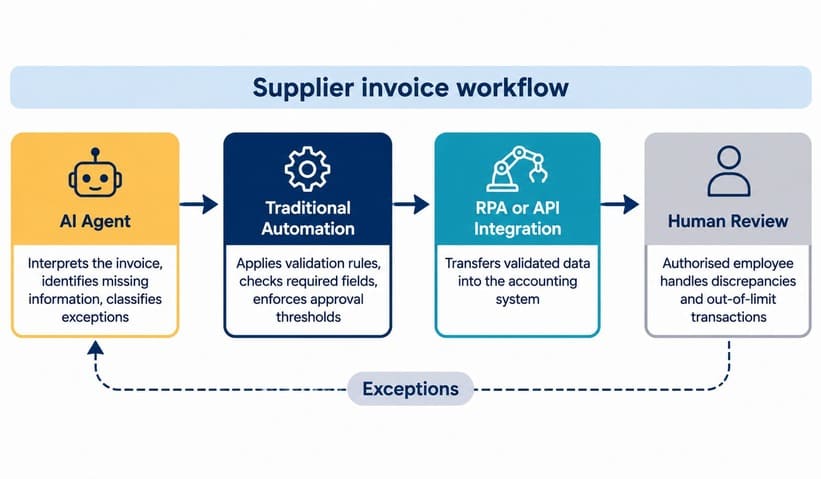
Consider a supplier invoice workflow:
- AI agent. Interprets the invoice, identifies missing information and classifies exceptions.
- Traditional automation. Applies fixed validation rules, checks required fields and enforces approval thresholds.
- RPA bot or API integration. Transfers validated information into the accounting system and updates the record.
- Human review, where required. An authorized employee handles discrepancies and transactions outside approved limits.
How to Choose the Right Automation Technology
Before investing in a solution, assess the process across several practical dimensions. A structured evaluation helps prevent organizations from adopting AI where a simpler approach would deliver the required outcome.
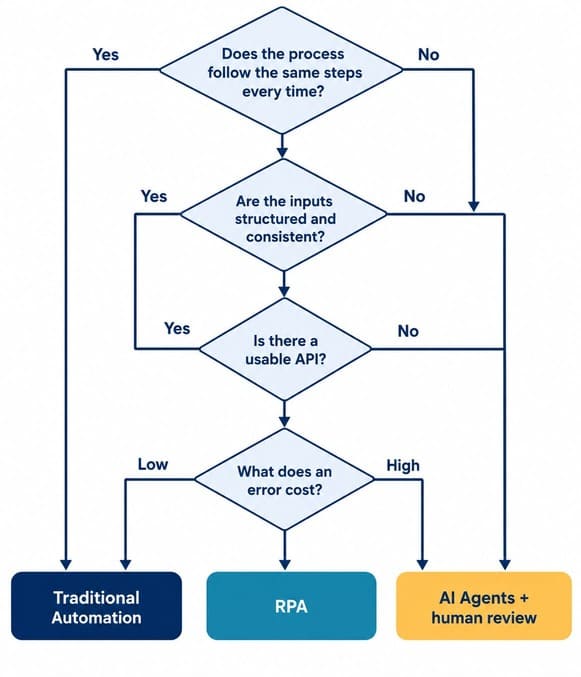
Step 1: Start With Process Stability
If a workflow follows the same steps every time and its rules rarely change, traditional automation or RPA is often sufficient. If the workflow involves changing inputs, ambiguous requests or unpredictable exceptions, AI may provide additional value.
Step 2: Assess Data and System Readiness
Review the availability, quality and accessibility of the information the workflow needs. Traditional automation generally benefits from structured inputs, while AI agents can interpret varied information when the solution has suitable models, context and validation mechanisms.
Step 3: Compare Total Cost of Ownership
Implementation cost is only one part of the decision. Consider licensing, development, integration, infrastructure, maintenance, monitoring, employee training and exception handling.
Step 4: Establish Risk and Governance Requirements
The amount of control must be based on the consequences of an error. A system that drafts an internal summary poses various risks from one that modifies the financial records or needs to make any decisions that will impact the customers.
How DSG Technologies Supports Intelligent Automation
The choice between AI agents, RPA and traditional automation is made under the condition of a certain knowledge of the business processes, technical dependencies and operational risk. The correct solution must be related to a real business issue and not a technology implementation which has no measurable purpose.
DSG Technologies’s AI and intelligent automation services covers opportunity assessment, readiness review, workflow design, build and integration, production deployment and ongoing performance monitoring.
Planning an automation initiative?
DSG Technologies’s AI and intelligent automation practice covers opportunity assessment, readiness review, workflow design, build and integration, production deployment and ongoing monitoring. We start by establishing whether a process needs an agent at all.
Book a workflow assessment → No obligation. Typically 45 minutes.

Related Articles


Recently Posted

When Microsoft 365 Goes Down: Is Your Business Continuity Plan Ready?
24 Nov 2026
What Enterprise AI Actually Costs: Pilot, Production and the Gap Between
24 Nov 2026
AI Agents vs RPA vs Traditional Automation: What Fits Which Process?
17 Nov 2026
AI Use Case Discovery: Choosing the First Three Processes to Automate
06 Nov 2026